
The First Five Minutes Decide Whether You Win the Job
Reply speed beats almost every other variable in lead conversion. Here's why the first five minutes matter, and how to cover them without hiring anyone.
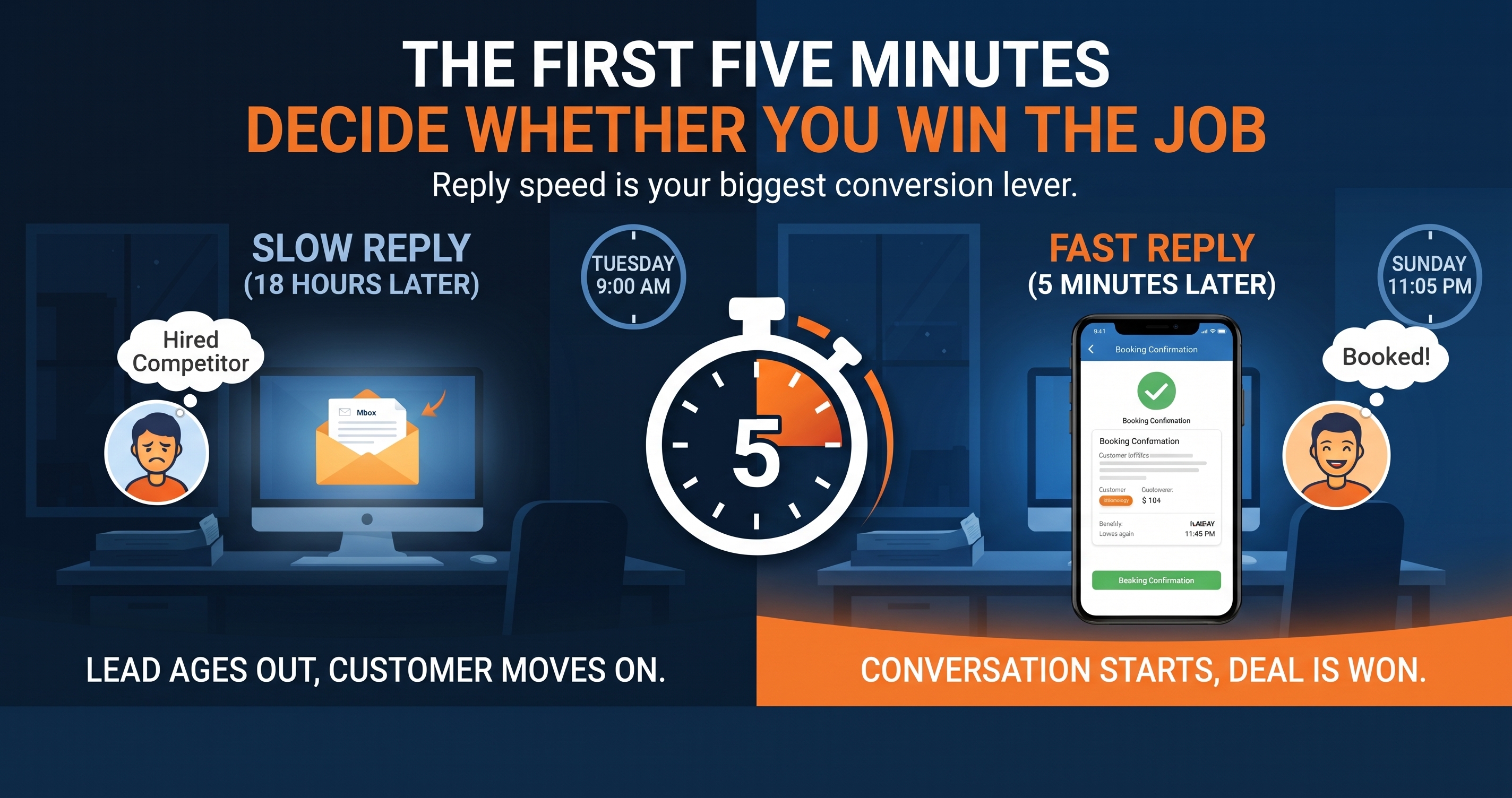
Speed of reply is the single biggest lever most businesses have over their conversion rate, and almost nobody is pulling it. Answer within five minutes and you're usually the only one who has. Answer the next day and you're often talking to someone who has already hired your competitor.
- The value of a reply decays fastest in the first hour, not the first day
- An automated first response counts — if it answers the question they asked
- The fix is one workflow, not a bigger team or longer hours
Here is the uncomfortable thing about most lead problems: they aren't lead problems. The inquiries arrive. Somebody fills in the form, or calls and doesn't get through, or sends a message at an hour when no reasonable person is working. The business has already paid for that person — through ads, through referrals, through years of being good at the job.
Then nothing happens for eighteen hours.
By the time someone opens the inbox on Tuesday morning, that inquiry has aged out of usefulness. Not because the person stopped needing the work done, but because they kept looking while they waited, and somebody else replied first.
Why speed beats almost everything else
When someone contacts three businesses about the same job, they are not running a careful evaluation. They are trying to get a problem solved. The first credible reply gets a disproportionate share of attention, because it arrives while the problem is still front of mind and before the other options have said anything at all.
This is why response time outperforms most of the things businesses spend money improving. A better hero image is worth something. Being the only one who answered is worth considerably more.
You are not competing on quality at this stage. You are competing on being present.
The effect compounds in an unhelpful direction, too. The slower you are, the more of your marketing budget is spent generating inquiries that were always going to be lost. You pay full price for the lead and collect a fraction of the value.
What counts as a real reply
There is a difference between a response and an acknowledgment, and most automated systems only manage the second one.
“Thanks for your inquiry, we'll be in touch shortly” is not a reply. It tells the person nothing they didn't know, gives them nothing to do, and quietly signals that the real answer is still hours away. They keep looking.
A reply that actually holds the conversation does three things:
- Names the thing they asked about. If they described a blocked drain in Northridge, say blocked drain and say Northridge. Specificity is what separates a message from a form receipt.
- Answers the obvious next question. Usually that's availability, rough price, or whether you cover their area. You know which question you get every time — answer it before they ask twice.
- Gives them something to do. A booking link, a time to confirm, a single question to reply to. A message with no action is a dead end.
How to cover the first five minutes without hiring
Nobody is suggesting you sit by a phone at midnight. The point of automating this layer is that it removes the need for anyone to be available at all, while still producing a response that reads as though someone was.
Start with one route, not all of them
Pick whichever channel brings the most inquiries — usually the website form or a missed call — and cover that one properly. A single workflow that works beats five that half-work.
Let it ask the questions you always ask
Job type, location, urgency, budget range if it matters. Two or three questions, no more. This turns a name and a phone number into a lead your team can act on, and it means the follow-up conversation starts from somewhere useful.
Route it, then let it rest
The workflow should tag the inquiry, drop it into the right pipeline stage, and notify whoever picks it up. Then it stops. Automation earns its keep by being bounded — anything requiring judgment waits for a person.
“Won't that feel impersonal?”
This is the objection we hear most, and it's worth taking seriously rather than dismissing.
Customers are not offended by automation. They are offended by irrelevance — being sent something that clearly went to a list, or being asked for information they already provided. A short message that references their actual request and offers a genuine next step does not read as robotic. It reads as a business that has its house in order.
And consider the alternative you're defending. Silence until Tuesday is not more personal. It's just slower.
Where to start this week
If you do nothing else: find out how long your last twenty inquiries waited for a first reply. Not your average — the actual list, including the ones that arrived at awkward hours. Most businesses are surprised, and the surprise is rarely pleasant.
Then cover the worst gap. That's usually evenings and weekends, and it's usually one workflow away from being solved. We wrote more about the systems layer underneath this in the piece on treating your website as a sales system, and about the broader problem on our losing leads page.
Common questions
How fast should you respond to a new lead?
Does an automated reply actually count?
What if we can't answer properly at 11pm?
Will customers be annoyed by an automated response?
What does it cost to set this up?
How long did your last inquiry wait?
Tell us how leads reach you today and we'll show you where the gap is — and what it would take to close it.