
Getting Found When People Ask an Assistant Instead of Searching
Search is splitting into three habits: typing, asking, and delegating. Here's what has to change on your pages so one page answers all three.
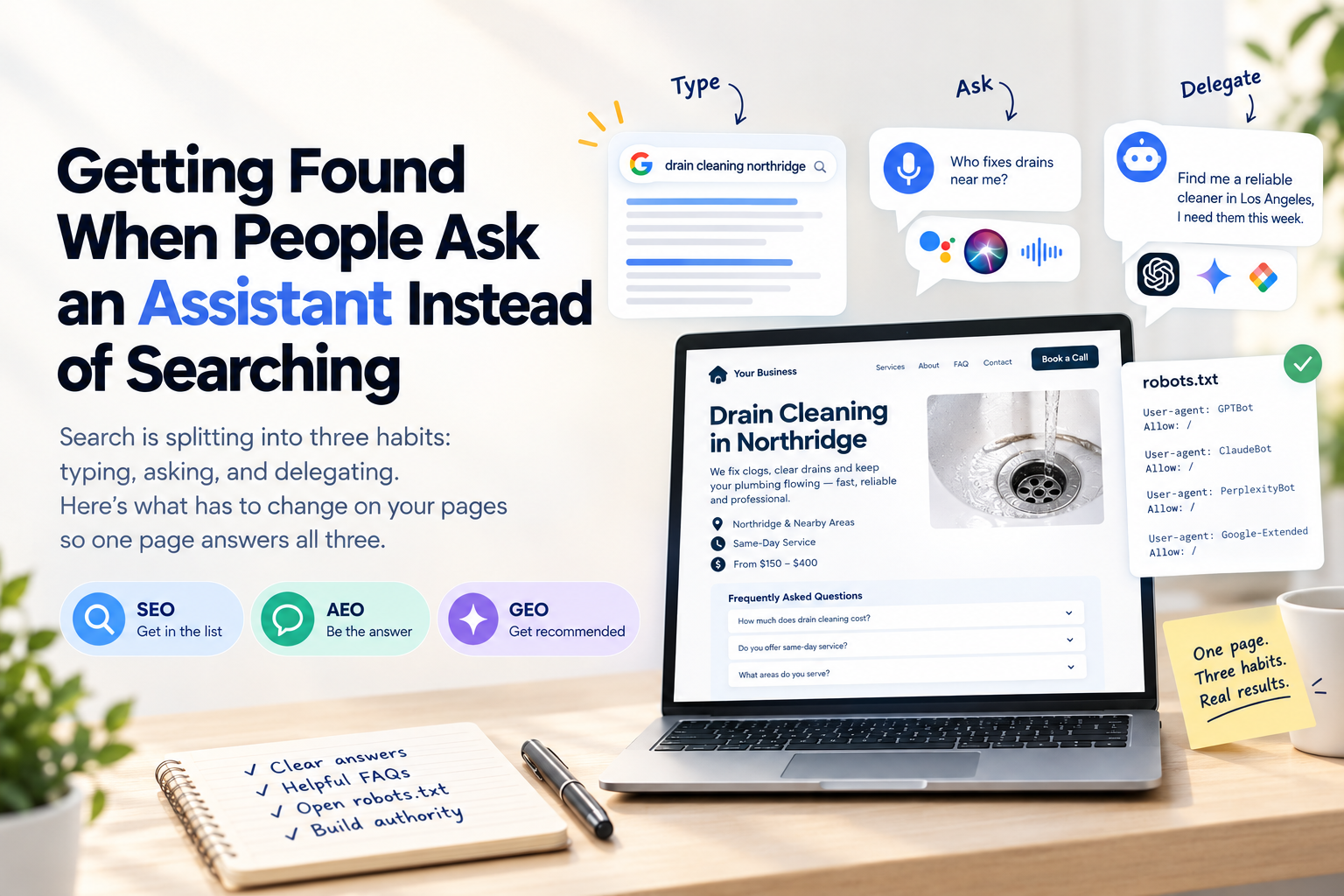
People now find businesses three different ways: they type a query, they ask a question out loud, or they hand the whole task to an assistant and accept its recommendation. One page can serve all three, but only if the answer appears near the top, the facts survive being quoted out of context, and your robots.txt actually lets the assistants read you.
- SEO gets you into the list of results
- AEO gets you into the direct answer above it
- GEO gets you named when there is no list at all
For twenty years the job was the same shape. Someone typed words into a box, ten links came back, and you fought to be one of them. Everything about how we write pages descends from that: the keyword in the heading, the long article that outranks the short one, the internal linking.
That habit still exists. It just isn't the only one any more.
Someone in a kitchen says “who does emergency plumbing near me” to a speaker and gets one answer, not ten. Someone else opens an assistant and types “find me a reliable cleaner in Los Angeles, I need them this week” and receives three names with reasons attached. Neither person sees your meta description. Neither one clicks a blue link.
The three habits, plainly
The acronyms are unhelpful, so here is what each one actually means for a business owner.
SEO: being in the list
Someone types, scans a page of results, and chooses. You need to rank, and you need a title and description that earn the click. This is the habit everyone already builds for.
AEO: being the answer
Someone asks a question and gets one response, spoken or shown at the top of the page. There is no list to be third in. Either your sentence is the answer or somebody else's is.
GEO: being recommended
Someone describes a situation to an assistant and asks it to solve the whole thing. The assistant reads, decides, and names a shortlist. You are either on it or you are invisible, and you never find out which.
In the first habit you compete for attention. In the other two you compete to be quoted.
Start by checking you are not blocked
Before writing a word, find out whether the assistants can read you at all. This is the most common problem we run into, and it has nothing to do with content quality.
Open yourdomain.com/robots.txt in a browser. Look for rules naming GPTBot, ClaudeBot, PerplexityBot, Google-Extended, or a blanket Disallow: / applied to everything. Plenty of sites carry these rules without anyone having decided to add them, inherited from a template, a plugin default, or advice from a few years ago when the sensible instinct was to keep bots out.
If you want to be readable, the file should say so explicitly rather than leaving it to interpretation:
User-agent: GPTBot
Allow: /

User-agent: ClaudeBot
Allow: /

User-agent: PerplexityBot
Allow: /

User-agent: Google-Extended
Allow: /
This is a decision, not a default. Allowing these crawlers means your pages can be used in answers and may be used in training. Blocking them means neither. We think most service businesses want to be found far more than they want to be withheld, but the choice should be made on purpose.
Write paragraphs that survive being lifted
Here is the mental shift that matters more than any technical fix. When an assistant answers a question, it is not sending someone to your page. It is taking a sentence off your page and using it, often with your name attached and often without the surrounding context.
So the sentence has to work alone.
Four things make a passage quotable:
- Ask the question as a heading, worded the way people say it. “How much does drain cleaning cost?” rather than “Our pricing structure.”
- Answer it in the first sentence underneath. Not after three sentences of preamble about your commitment to quality. The first sentence is the one that gets taken.
- Keep each fact self-contained. “It typically costs between $150 and $400” is useless when lifted. Name the thing: “Domestic drain cleaning in Los Angeles typically costs between $150 and $400.”
- Say who you are in full, on the page. Assistants resolve entities, not pronouns. “We serve the Valley” tells them nothing. “Creovant Digital works with clients in the US and the Philippines” can be repeated back accurately.
The structural work that serves all three
None of this requires separate content for AI. It requires the page to be organized for extraction as well as for reading.
Put a short answer near the top of every important page
Two or three sentences that answer the page's core question before the marketing starts. Humans skim it, snippets pull it, assistants quote it. We add one to every service page we build for this reason.
Use real FAQ sections, and mark them up
Questions you genuinely get asked, answered in full, with FAQ schema attached. This is the single highest-yield structural change on most sites, because the question-and-answer shape is exactly what an answer engine is looking for.
Be explicit about place, service and price
Vagueness reads as evasion to a person and as missing data to a machine. Name the areas you cover, the services you offer, and at least a range for what things cost. A page that hides its prices cannot be recommended by something that has been asked to find affordable options.
Add structured data and keep it honest
Organization, LocalBusiness, Service, FAQPage and BreadcrumbList markup remove ambiguity about what your page is and who published it. It will not force a citation, but it makes you easier to summarize correctly, and correctness is what earns the mention.
What you cannot fix on your own site
One uncomfortable part of this: assistants do not only read your pages. They read what other sites say about you.
If your business is barely mentioned anywhere beyond its own domain, there is less for an assistant to draw on and less reason to trust what it finds. Directory listings, a complete and accurate business profile, genuine reviews, supplier and partner pages, local press, and any coverage naming you all feed the same picture. This is what the link-building world spent years chasing, arriving at the same answer from a different direction.
You do not need many. You need enough consistent mentions that your name, your location and your services resolve to one clear entity rather than a guess.
What we actually change on a build
On a typical website project, the search work is not a separate phase. It sits inside the structure:
- Every service page opens with a direct answer to the question that page exists for
- Headings are written as questions where people ask them that way
- FAQ sections come from the questions the client actually fields on the phone, not from a keyword tool
- Business name, service area and service list appear in full on the page, not only in the footer
- Schema is generated for the organization, the services and the FAQs
- robots.txt is checked and set deliberately before launch
None of it is exotic. It is mostly a matter of writing the page in the order the reader needs rather than the order the business wants to talk.
Common questions
What is the difference between SEO, AEO and GEO?
Do I need separate content for AI search?
How do I check whether AI crawlers can access my site?
Does blocking AI crawlers protect my content?
Is schema markup still worth adding?
How long does it take to show up in AI answers?
Can an assistant describe your business correctly?
Ask one. If the answer is vague, wrong, or about somebody else, that is a fixable problem and a good place to start.