
How to Vet a Web Design Agency Before You Hire One
Five checks that separate an agency worth hiring from one that will cost you a year. What to ask, what to look for, and where to verify it independently.
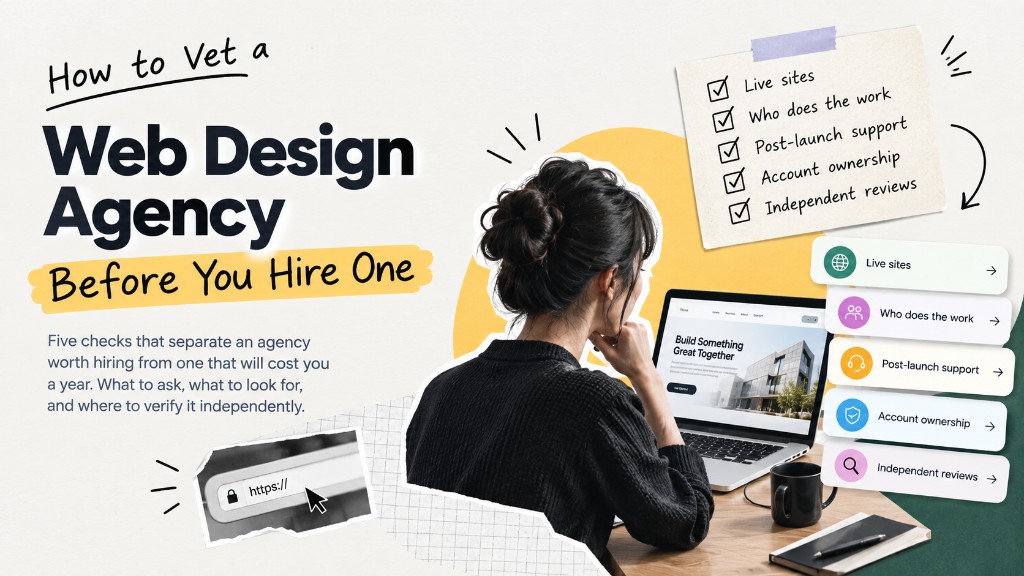
Most bad agency experiences are predictable from the sales call. The warning signs are not price or polish, they are vagueness about who does the work, what happens after launch, and who ends up owning the accounts.
- Ask for live URLs, not screenshots
- Find out who builds it, not just who sells it
- Check the domain and hosting go in your name
- Verify them somewhere that isn't their own website
Hiring someone to build your website is an uncomfortable purchase. You are buying something you cannot inspect in advance, from a field where the vocabulary is deliberately fuzzy, and you usually only find out whether it worked six months later.
We pick up a steady stream of projects from agencies that went wrong. The pattern barely changes, and it is almost never about skill. It is about questions nobody asked at the start.
1. Ask for live sites, not screenshots
A portfolio page of beautiful mockups proves someone can design. It does not prove anything was built, launched, or survived contact with a real client.
Ask for URLs. Open them on your phone, not your laptop, because that is where most of their visitors are. Check the load speed, submit the contact form, and see whether anyone has touched the site since launch. If a case study has no link attached, ask why. Sometimes there is a good reason, such as a client under NDA or a site since redesigned. Sometimes there isn't.
Anyone can show you a picture of a website. Fewer people can show you one that is still running.
2. Find out who actually does the work
This is the question that catches the most people out. The person on the sales call is often not the person who will build your site, and in larger agencies your project may pass through three people before anything is designed.
That is not automatically bad. You just need to know before you sign. Ask directly:
- Who will I be speaking to during the project?
- Is that the same person doing the work?
- If something is wrong in week three, who do I message?
A clear answer is a good sign regardless of the structure. A vague one usually means the work is being routed somewhere the salesperson would rather not describe.
3. Ask what happens the day after launch
Launch is the moment most agency relationships quietly end, and it is also the moment problems appear. Forms stop sending, a plugin breaks, someone needs to change the opening hours and cannot find where.
Before you sign, get specifics on three things: how long the support window lasts, who trains your team, and what is written down. Documentation matters more than goodwill here, because goodwill leaves when the person who built it moves on.
4. Check whose name the accounts are in
This one costs businesses more than any design decision, and it is invisible until you try to leave.
Domain, hosting, analytics, CRM, ad accounts. All of it should be registered to your business, with you as the owner and the agency as a manager or collaborator. Plenty of agencies set these up under their own accounts, usually for convenience rather than malice, but the result is the same: changing supplier turns into a negotiation.
Ask the question plainly. “If we part ways in a year, what do I keep and what do I lose?” The answer should be that you keep everything.
5. Verify them somewhere that isn't their website
Every agency site says the same things. Trusted. Results-driven. Passionate about your success. None of it is checkable, because they wrote it.
Independent evidence is worth more. Look for reviews on platforms the agency does not control, listings on third-party directories that verify the businesses they publish, and client references you can genuinely contact rather than logos arranged in a grid.
Marketplaces such as DesignRush sit in that second category, listing and reviewing agencies by specialism so you can compare several without relying on each one's own description of itself. You can see our profile and confirm we are DesignRush verified alongside other studios working in the same space.
None of this replaces a conversation. It just means you arrive at the conversation knowing the business exists, does the work it claims, and has a record somewhere other than its own homepage.
Good answers vs answers that should worry you
Print this, or keep it open on the call. The wording varies, the shape does not.
| You ask | A good answer sounds like | A weak answer sounds like |
|---|---|---|
| Can I see live sites? | Sends URLs without being asked twice, including one similar to your business. | Sends a PDF, or images with no links, or work that is “under NDA” across the board. |
| Who builds it? | Names the person, and that person is on the call or joins the next one. | “Our team handles it” with no names and no introduction offered. |
| What happens after launch? | A stated support window, training, and written documentation at handover. | “We're always here if you need us,” with nothing in the proposal. |
| Who owns the accounts? | Registered in your business name, with the agency added as a manager. | “We'll set all that up on our side, it's easier.” |
| What does it cost? | A published or scoped figure and a defined deliverable after a scoping conversation. | An hourly rate with no ceiling, or a number that changes when you hesitate. |
| Where else can I check you? | Points you to reviews, directory listings and contactable references. | Points you back to testimonials on their own website. |
Four answers that should slow you down
- “We'll handle the domain for you.” Helpful in tone, expensive in practice. Fine if it is registered in your name.
- “Guaranteed first page on Google.” Nobody controls the results page. A guarantee here means either a meaningless keyword or a misunderstanding of how ranking works.
- “We can start Monday.” Sometimes true. Often it means no discovery, which means the scope will change and so will the price.
- Silence on what happens after launch. If handover and support are not in the proposal, they are not in the project.
For what it is worth, our answers
It would be strange to publish this without answering it ourselves, so: the person who scopes your project is the person who builds it. Every site in our work is a live URL you can open. Accounts are registered in your name, and you keep everything if you leave. Support is 7 days on smaller builds and 30 on packages, with training and a written runbook at handover. Pricing is published rather than quoted on request.
Ask any agency these five questions. The good ones will answer without hesitating, and the answers will match what you find when you check.
Common questions
What should I ask a web design agency before hiring them?
How do I know if an agency's portfolio is real?
Should I hire a freelancer or an agency?
Who should own the website domain and hosting?
How can I check an agency independently?
How much should a small business website cost?
Putting us through the same five checks?
Ask away. We'll answer all five in writing before you commit to anything.